

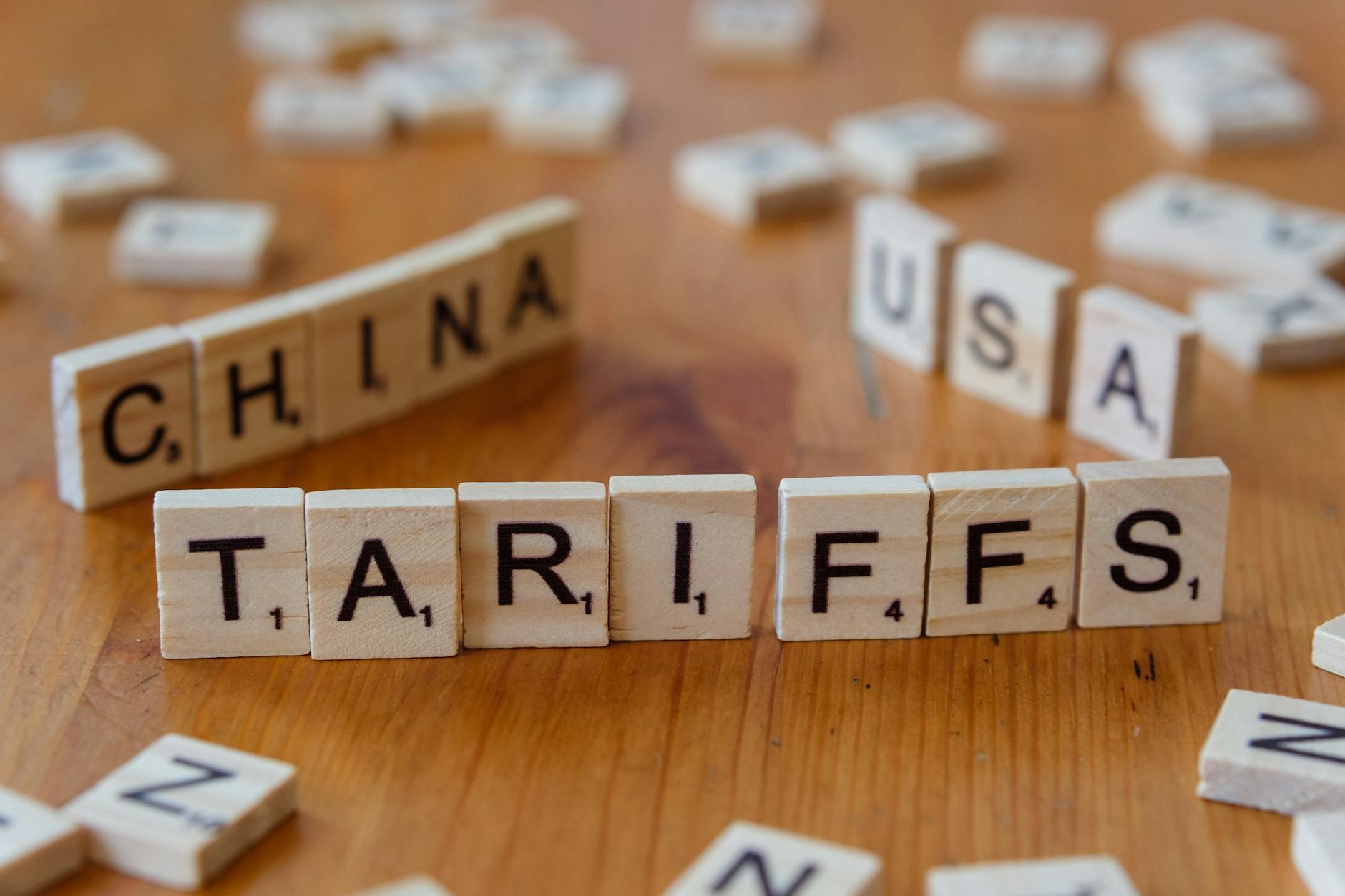
A completely reasonable response to an unreasonable political news cycle.
White House Insists ‘Strategic Ambiguity’ Means Not Even Staff Know What’s Going On
After months of aggressive rhetoric, half-written executive orders, and several “totally historic” announcements of things that did not actually happen, the Trump administration’s China strategy has reportedly entered a bold new phase known internally as “we’ll see.” According to senior officials, this is a highly sophisticated doctrine in which tariffs, threats, and compliments are deployed in random order until either Beijing gives in or everyone forgets what the initial goal was.
The policy, aides say, is still “firmly under development,” a phrase that in this White House has come to mean “being rewritten mid-sentence.” The tariff push, once sold as the central lever of American leverage, has stalled in Congress, the business community, and occasionally in the President’s own attention span.
Tariffs, Sanctions, and a Wheel of Fortune
In place of a coherent blueprint, officials have assembled what one National Security Council staffer, speaking on background, described as “a menu of options and a spinning wheel.” The wheel, used in internal briefings, reportedly includes sectors to target, messages to send, and a small wedge labeled “congratulate Xi on something vague.”
“One day we’re threatening 60 percent tariffs, the next day we’re talking about being very good friends again,” said a senior trade official, who asked not to be named because he still wants a job after November. “We call it a ‘dynamic, data-driven approach.’ By ‘data’ I mean cable news segments, and by ‘driven’ I mean driven by whatever he saw most recently.”
At the heart of the confusion is a clash between economic advisers who want a narrowly targeted strategy and political aides who want something that looks tough on television. The result has been a steady stream of policy announcements that cancel each other out like badly written math homework.
One week, the White House signals crippling new tariffs. The next, senior officials clarify that the tariffs are actually “conceptual,” “aspirational,” or “not to be taken literally by markets, allies, or anyone who can read.” The week after that, the President hints he might delay them “depending on how respectful” Chinese officials are during his next rally.
“We have a very clear strategy on China,” insisted one senior official on a conference call with reporters. “But we are not going to reveal it, even to ourselves, because that would undermine its strategic flexibility.”
Markets, as usual, reacted with steady confusion, rallying and plunging in alternating shifts as algorithmic traders tried to convert presidential adjectives into bond yields.
When Every Signal Is a Mixed Signal
The confusion has been amplified by a barrage of conflicting public messages. On Monday, the administration suggested China was a “grave national security threat.” On Tuesday, it welcomed Beijing’s “tremendous role in the global economy.” By Wednesday, an official clarified that China was “both a friend and a rival,” and by Thursday the President described Chinese leaders as “smart, tough, not as tough as me, but very tough, great people, very unfair, but also very fair when you think about it.”
Diplomats in Beijing, struggling to decode the shifting mood, have reportedly resorted to charting presidential statements on a wall-size board, color-coded by tone and time of day. One European ambassador, requesting anonymity, said the U.S. line on China now resembles “an especially chaotic weather map, but for tariffs.”
In an effort to impose order, the National Security Council recently circulated a draft internal document titled “Integrated China Strategy Framework.” Sources say the 27-page file mostly consists of competing bullet points, track changes, and the phrase “to be determined” repeated in slightly different fonts.
“We are operating under what we call a ‘multi-vector, cross-pressured, posture-adaptive paradigm,’” explained a senior NSC official. “That means that if you don’t understand what we’re doing, that’s actually part of the plan.”
The Pentagon, meanwhile, has tried to maintain a steady deterrence posture, quietly conducting freedom-of-navigation operations in the South China Sea while State Department spokespeople assure reporters that everything is fine and not, in fact, quietly on fire.
The Official Explanation: Quantum Strategy
Pressed to explain the apparent contradictions, the White House unveiled what it called a “cutting-edge” framework: Quantum Strategy.
According to a fact sheet distributed to reporters and later rescinded, American policy toward China “exists in multiple states simultaneously—confrontation, cooperation, confusion—until measured by an external observer such as the Wall Street Journal.” The sheet compared the approach to “Schrödinger’s Tariff,” describing a measure that is both in effect and not in effect until the President is asked about it on live television.
“People say it’s mixed messaging,” one communications aide said. “No. It’s quantum messaging. It’s much more advanced. Our policy is both hawkish and dovish, which frankly makes it a very powerful bird.”
To underscore the point, the White House scheduled a series of events featuring CEOs praising the China tariffs in the morning, followed by lobbyists urgently explaining in the afternoon why those same tariffs should never, under any circumstances, be implemented.
Escalation by Calendar
As the election year has intensified, so has the rhetoric. The administration reportedly maintains three separate draft China strategies: a “base strategy” for rallies, a “business strategy” for donor calls, and a “allies strategy” for whenever a European leader looks visibly alarmed.
In an especially innovative move, the Office of the U.S. Trade Representative tested a pilot program in which tariff plans are announced only on days when the stock market is closed, in hopes investors will “just sleep through it.” The trial was suspended after Asian markets, inconveniently in different time zones, reacted anyway.
The turning point came when someone suggested aligning all China messaging across agencies. The attempt lasted three hours, produced six contradictory draft statements, and ended when the President rewrote the talking points himself while live on a phone interview.
This moment of escalation prompted the creation of an internal “China Message Coordination Task Force,” which meets twice a week to harmonize talking points that are then discarded the following day.
“We have a lot of different voices on China, which shows how vibrant our democracy is,” said one official. “China only has one voice. We consider having eight incompatible positions a strategic advantage.”
Everyone Is Very Tough, for Now
Business leaders, after initially cheering the promise of a level playing field, now mostly want to know what country they’re allowed to manufacture in this quarter. Trade lawyers report brisk demand for seminars titled “Is This Tariff Real?” and “How to Interpret a Policy That Might Be a Tweet.”
Meanwhile, Beijing appears to be pursuing its own long-term strategy while quietly developing a parallel department tasked solely with interpreting U.S. presidential interviews. According to diplomatic cables, Chinese officials have adopted a simple working assumption: the United States is simultaneously bluffing, serious, confused, and campaigning in Wisconsin.
In private, some American officials concede the obvious.
“Look, we know we need a coherent China policy,” admitted one seasoned diplomat. “But that would require trade-offs, priorities, and staying on message for more than 36 hours. Right now, the system is optimized for none of those things.”
For the moment, the world’s two largest economies remain locked in a standoff in which each side is waiting for the other to blink, or in Washington’s case, to check the polls. The tariffs might go up, they might go down, or they might stay exactly where they are while being loudly described as something else.
In a way, there is consistency. Every signal, every reversal, every trial balloon and walk-back ultimately communicates the same core message: America is very serious about China—just as soon as it decides what that means.
Reality Check
The real news: Reporting indicates that Donald Trump’s China policy has become increasingly inconsistent, with aggressive tariff threats stalling and different parts of his team sending conflicting signals about the administration’s goals. Business groups, allies, and markets are struggling to interpret what U.S. strategy actually is. The satire above exaggerates this confusion, but it’s rooted in genuine concern that Washington lacks a clear, stable long-term approach to managing competition with Beijing.
Satire disclaimer: This article is satire and parody. It is not factual reporting.
Original source: Modern Diplomacy
Image credit: Markus Winkler — source. Show a visible credit link to Pexels on the site.