

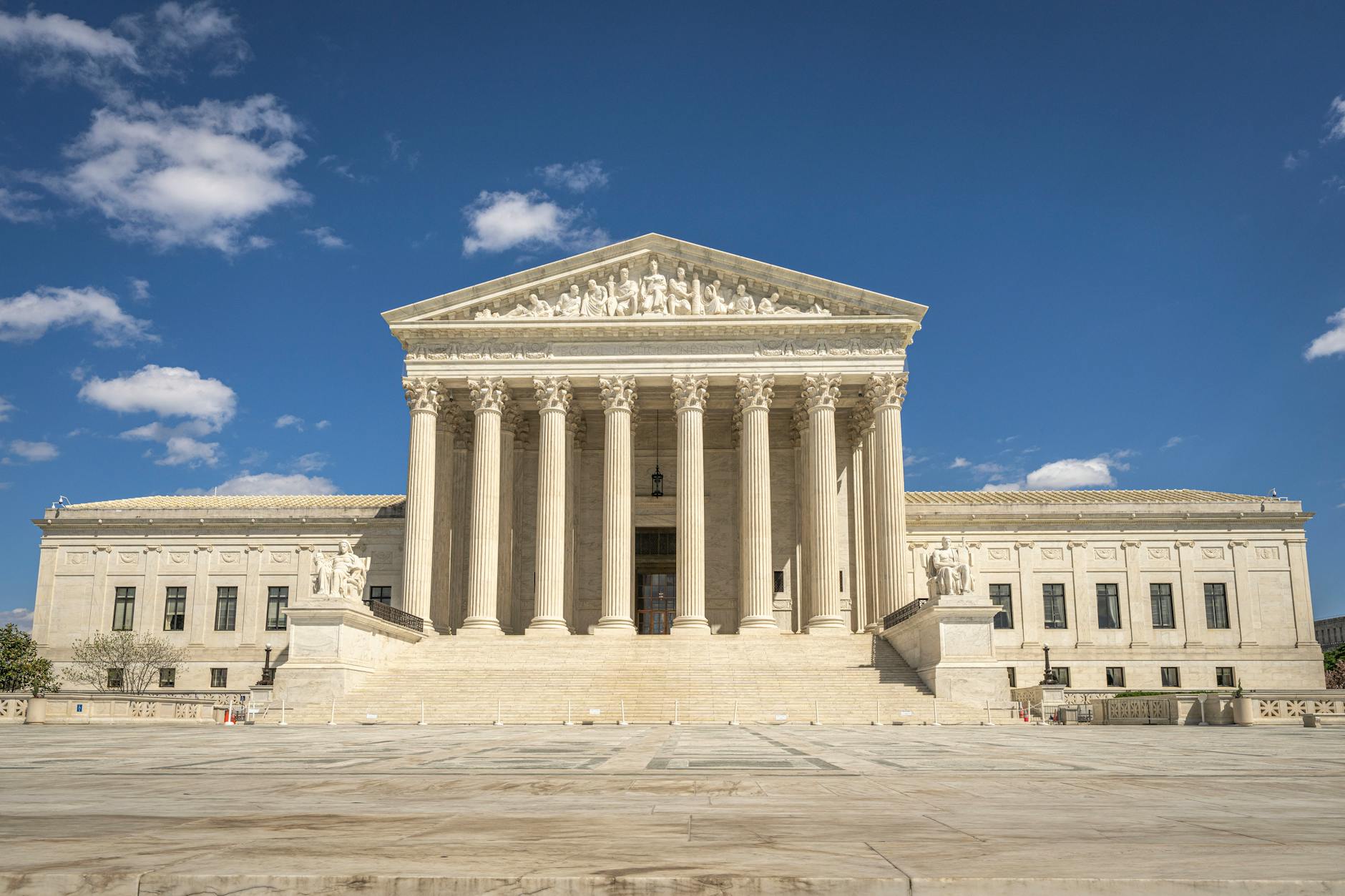
A completely reasonable response to an unreasonable political news cycle.
In a bold new strategy that finally answers the question “What if governing, but as a sweepstakes?”, Senate Republicans have reportedly decided that their best chance to keep control of the chamber is not legislation, not policy, and certainly not talking to voters, but a dramatic, last‑minute Supreme Court “surprise” that will turn the 2024 map around faster than you can say “jurisprudential Hail Mary.”
According to aides, this is not to be confused with “court-packing.” This is “court-unboxing.”
“We’re not saying we’re running on the Supreme Court,” said one senior GOP strategist, speaking on background from a Capitol Hill office decorated exclusively with framed Federalist Society swag. “We’re saying we’re outsourcing the campaign to the Supreme Court. It’s called efficiency.”
The New Get-Out-The-Vote Plan: Hope the Justices Do It
With grim polling in several battleground states and voters persistently insisting on “issues that affect their lives,” Republican senators have discovered a more reliable path: praying that the nine-member, lifetime-appointed panel down the street will drop a blockbuster ruling in late October that conveniently rearranges the political landscape.
“We’re optimistic the Court will hand down a decision that reminds voters who gave them this majority in the first place,” said one senator up for re-election, while carefully positioning himself in front of an American flag and a framed photo of himself not being indicted. “We’re not telling them what to decide, obviously. We’re just…manifesting.”
A leaked internal memo, marked “CONFIDENTIAL: DO NOT LEAK ONTO MSNBC AGAIN,” outlines several potential “surprises” that strategists believe could galvanize their base:
• A ruling redefining “presidential immunity” as “whatever you can do while thinking real hard about the national interest.”
• An opinion formally declaring that polls showing Democrats up 5 points are “constitutionally suspect.”
• A 6–3 decision holding that early voting must be conducted on Supreme Court steps in the presence of at least one sitting justice and a modestly priced donor reception.
The document also floats the idea of a major ruling on China, Iran, or whatever is trending in the Fox chyron rotation that week, under the legal theory of certiorari by cable segment.
“We respect judicial independence,” insisted one party spokesperson. “We simply believe the Court, in its independent wisdom, will independently do something that independently helps us exactly when we independently need it.”
The Court as Campaign Consultant
Campaign aides quietly admit this is not a traditional midterm strategy, but argue that traditional midterm strategies require talking about Donald Trump, inflation, abortion, Ukraine, China, Iran, and whatever the Supreme Court did last term. They have instead chosen to do what has worked so well in the past: transfer political responsibility to an institution they’ve already turned into a campaign prop.
One senator reportedly told colleagues in a closed-door lunch, “Look, I could try to explain our health care plan, or I could say ‘Supreme Court majority’ and watch the donations roll in. I follow the data.”
Pressed on what specific “surprise” they’re hoping for, leadership staff used remarkably consistent language, suggesting at least three draft cycles of focus-grouped vagueness.
“We’re confident the Court will remind voters of the importance of stability, the rule of law, and whatever talking point polls best this week,” said a senior aide. “We don’t know what case it will be; that’s the beauty of it. It’s like legal advent calendar politics.”
Democrats, for their part, condemned the strategy as “dangerous politicization of the judiciary” before immediately fundraising off the exact same Supreme Court and sending out an email blast with the subject line: “Mitch McConnell thinks he owns the Court. Prove him wrong for just $7.”
Escalation: The “Surprise Calendar” Leak
The arrangement might have remained a matter of speculation if not for a subsequent leak revealing a color-coded “Supreme Court Surprise Calendar” circulating inside a Senate campaign committee. The spreadsheet allegedly predicts rulings by topic and political impact, with helpful columns like “Effect on rural turnout” and “Chance of triggering MSNBC emergency panel.”
Under “Late June,” the sheet lists: “Major presidential immunity decision – base fired up, moderates dizzy.” Under “September,” it proposes: “Election law ruling – too complicated for voters to fully understand but definitely good for fundraising.”
In the “October Surprise” row, the entry simply reads: “CLASSIFIED – check with Leonard.” Staffers insist this is a reference to Leonard the IT guy, who allegedly forgot to lock his screen last time, and definitely not to any particular conservative legal activist who may or may not exist only as a vague presence in every news story.
When asked whether this implied coordination with the Court, one campaign lawyer offered an elaborately technical denial.
“To be very clear, we are not communicating with the Supreme Court about pending decisions,” the lawyer said. “We are merely constructing hypothetical fan fiction of possible outcomes and then organizing our entire electoral strategy around the assumption that our favorite chapters become canon. This is a normal, non-problematic thing for a democracy to do.”
The Court, maintaining its customary silence, did not comment, although an anonymous law clerk was spotted taking notes at a nearby think tank panel titled “Originalism, Administrative Law, and Helping Vulnerable Incumbents in Toss-Up States.”
The Official Explanation, Such as It Is
Faced with mounting criticism, Senate GOP leadership released an official explanation of their strategy in the form of a carefully crafted statement printed on heavy, respectable paper:
“The Supreme Court is a co-equal branch of government. As such, we categorically deny any improper reliance on the Court to propel our party to electoral victory. Our approach is grounded in long-standing constitutional principles, the separation of powers, and the time-honored Senate tradition of putting all of our political eggs in one nine-person basket and then shaking it vigorously every election year. Any suggestion to the contrary is misinformation, disinformation, or pre-information, depending on the news cycle.”
The statement also assures Americans that decisions are not being timed to aid Republicans, explaining that “any overlap between politically useful rulings and precarious Senate races is purely coincidental, wholly random, and also vigorously protected by attorney-client privilege.”
Behind the scenes, consultants are reportedly preparing contingency plans in case the “surprise” is not as electorally beneficial as hoped. These include: blaming the media, blaming China, blaming Iran, and, in one particularly ambitious scenario, blaming the Federalist Papers for being “too open to creative reinterpretation.”
Meanwhile, in the Real World
While Senate Republicans stage-manage their expectations around the Court’s docket, voters continue to reference tangential concerns like “the economy,” “health care,” and “living on a planet with weather.” Campaign staff, however, remain confident that one well-timed ruling on executive power, social regulation, or electoral rules can override years of lived experience.
“The idea that we should win or lose based on our records is a very 20th-century mindset,” explained one strategist. “We’re in the streaming era now. People expect a twist ending.”
As Election Day approaches and the Court prepares to release its final opinions of the term, both parties quietly hover outside the marble building like fans at a movie premiere, hoping their preferred franchise gets renewed for another season. The justices, who insist their work is wholly independent of politics, will soon emerge with rulings that, by sheer coincidence, will be instantly categorized as “wins” and “losses” on cable news chyrons for the next six months.
And if the surprise doesn’t save the Senate majority, Republicans are already testing a backup message for 2026: “Give us more seats, and this time we promise the Court twist will really deliver.”
Reality Check
The real news: Senate Republicans are reportedly banking on upcoming Supreme Court decisions to reshape the political environment in ways that could help them hold or gain seats in 2024. They believe high-profile rulings on issues tied to Trump, executive power, or election rules could energize conservative voters and reframe campaign debates. The story reflects how both parties increasingly treat the Court as a central political actor rather than a distant, neutral arbiter. The satire above exaggerates this dynamic, but it’s rooted in genuine concerns about the judiciary’s growing role in electoral politics.
Satire disclaimer: This article is satire and parody. It is not factual reporting.
Original source: MSN
Image credit: Mark Stebnicki — source. Show a visible credit link to Pexels on the site.