

A completely reasonable response to an unreasonable political news cycle.
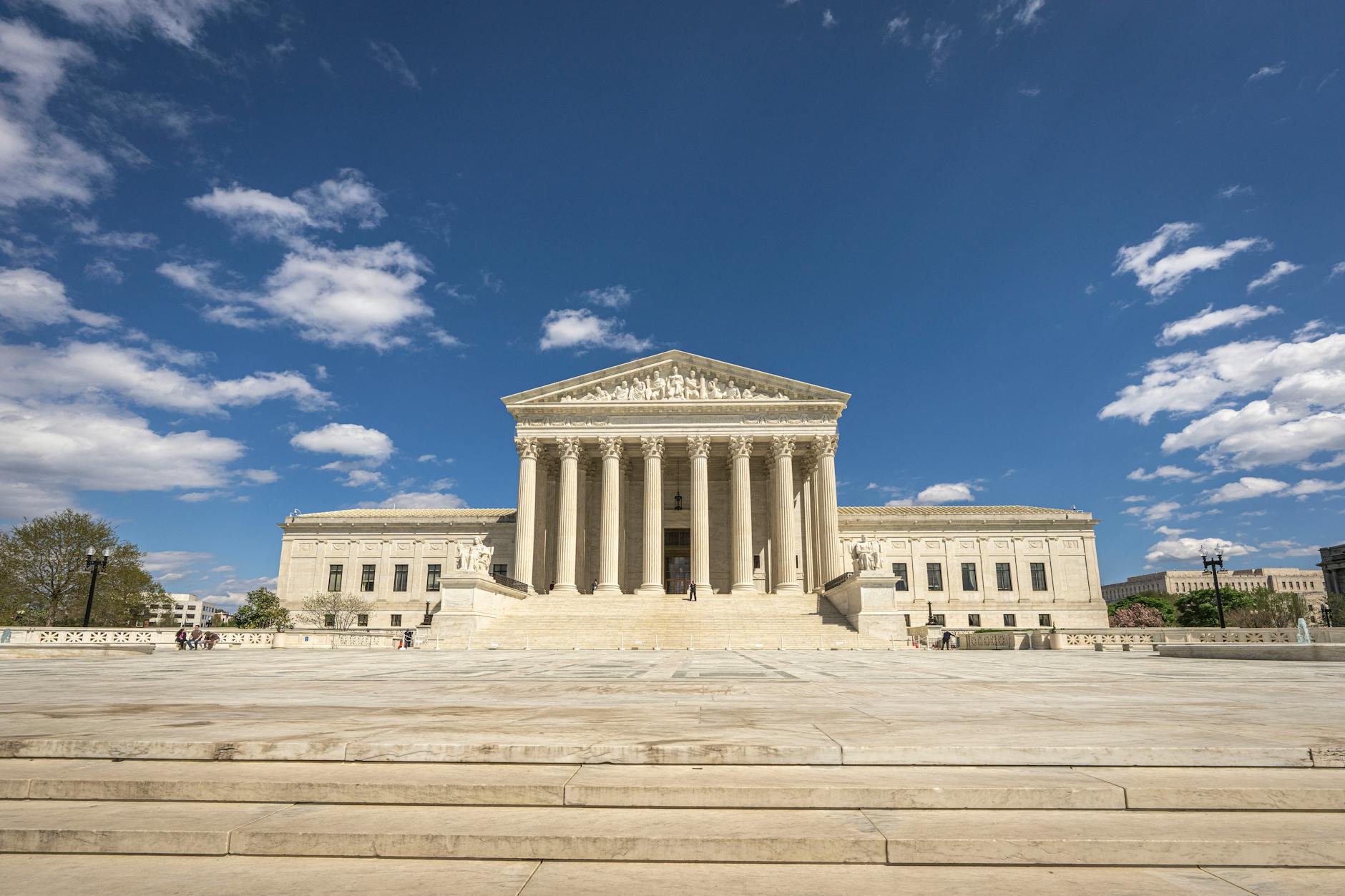
Witnesses say Donald Trump’s mood turned sour this week when he was informed, apparently for the first time, that the Supreme Court does not operate as a customer service desk for presidents seeking $159 billion in tariff refunds and temporary suspension of the 14th Amendment.
In a series of posts, Trump attacked the Court for decisions that could lead to tariff repayments and for its stubborn insistence that birthright citizenship is not something a president can unplug like a malfunctioning router. “The Supreme Court has gone CRAZY,” he wrote, confirming many legal scholars’ long-held fear that he just found out it’s not technically his in-house legal department.
The Court Fails to Honor Store Credit Policy
At the center of the week’s outrage: the possibility that U.S. importers could seek over $159 billion in tariff refunds after a key ruling limiting how far presidents can stretch trade laws before they snap back and hit everyone in the face.
Trump interpreted this as a direct personal insult, calling the potential refunds “a perfect example of legal WITCH HUNT by calculator” and accusing the justices of “giving $159 BILLION to China, Iran and probably Hunter Biden.” He did not explain the mechanism by which U.S. businesses filing for refunds would transform into foreign adversaries, but aides say “he feels it very strongly.”
“We didn’t think we had to tell him tariffs are paid by Americans,” said one exhausted trade attorney, speaking on background. “It’s literally the first slide in every PowerPoint. Right after the one labeled ‘No, You Can’t Just Declare Yourself Emperor of Steel.’”
According to a leaked internal memo, Trump had been under the impression that tariffs were a sort of global cover charge that foreign countries wire directly to his personal scoreboard. The Supreme Court’s refusal to endorse this economic theory has been described in conservative media as “judicial overreach into the sacred realm of fantasy policy.”
“This Court has become totally political,” Trump complained in a fundraising email, “refusing to let your Favorite President keep $159 BILLION that China owes us for being very unfair, and maybe for the Revolutionary War, I don’t know, people are saying that.”
In an “official explanation” circulated by allies on Capitol Hill, the situation was clarified this way: tariffs are “like a very strong wall made of money,” and any Court ruling that interferes with that wall “automatically helps Iran, China, globalists, and people who say ‘Happy Holidays.’” Economists attempted to correct the record, but their charts were ruled inadmissible for containing numbers.
Birthright Citizenship, Now with Optional Subscription Plan
Alongside the tariff meltdown, Trump also renewed his promise to end birthright citizenship “on day one,” apparently hoping the Supreme Court can be bullied into rewriting the 14th Amendment so it functions more like a streaming service with regional restrictions.
“No one really understood the 14th Amendment until I came along,” Trump posted, accurately describing the moment he first realized it applied to people he didn’t like. He argued that the phrase “born or naturalized in the United States” was clearly intended to exclude anyone whose parents failed his retroactive vibes test.
“We’ve checked the text,” said one weary constitutional scholar. “It doesn’t say ‘subject to the jurisdiction thereof, unless Fox & Friends has concerns.’”
Conservative lawmakers quickly rallied behind the proposal, with one senator insisting on cable news that “the founders never intended citizenship to be a lifetime plan; at most, they were thinking of a free trial with limited features.” When pressed on where this appears in the Federalist Papers, he replied, “spiritually.”
The Court, for its part, has so far maintained the controversial position that amending the Constitution usually involves more than a social media post and a fundraising link. Legal analysts say this puts the justices in direct conflict with a rising theory of executive power known as “Because I Said So, That’s Why.”
Escalation: Supreme Court Accused of Aiding Iran, China, and Babies
As the week progressed, the dispute escalated from a technical legal disagreement into a full-fledged geopolitical melodrama. By midweek, various Trump-aligned commentators were explaining that the Supreme Court’s alleged softness on tariffs and birthright citizenship would simultaneously enrich China, empower Iran, and incentivize “millions of strategic babies” to invade the United States by being born here.
“Look, the Chinese are very smart,” said one television pundit. “They see the Supreme Court telling us we can’t charge whatever we want and we can’t turn off citizenship like a light switch, and they’re laughing. Next thing you know Iran is opening a baby factory in Tijuana. That’s just common sense.”
In a particularly strained flourish, one House member suggested on the floor of Congress that the Court’s rulings could “force America to refund tariffs to woke corporations that secretly answer to Beijing,” thereby completing a circle of logic so tight it collapsed into a single vibrating talking point.
Pressed for comment, a trade law expert noted that the Constitution does not, in fact, contain an exception for “times when the math makes a president look bad.” The observation was immediately denounced as “academic elitism” by a panel of people whose core expertise is looking angry into cameras.
“We have a Supreme Court that cares more about so-called ‘laws’ than about how upset President Trump feels about them,” said a former administration official. “That’s not the America I remember from, roughly, 2017 to early 2021.”
Congress Considers Bold Plan to Understand None of This
Congressional leaders, desperate not to be left out of the drama, announced a series of hearings to “investigate judicial overreach” that, according to staffers, will focus on aggressively not reading the actual opinions.
One draft agenda for the hearings included the following items: “1) Why can’t the president just overrule the Supreme Court? 2) What even is a tariff, emotionally? 3) Can we impeach the 14th Amendment for disloyalty?” The hearings were postponed after several members attempted to subpoena Marbury v. Madison.
In closed-door meetings, some Republicans reportedly expressed concerns that repeatedly attacking the Court for upholding constitutional limits might backfire. These concerns were immediately resolved when polling showed that phrases like “Deep State Supreme Court” resonated strongly with voters who believe checks and balances are a brand of patriotic vitamins.
For now, the uneasy standoff continues: a Supreme Court timidly suggesting that laws still apply, a former president insisting that money he never personally touched is being stolen from him, and a Congress bravely refusing to bring a calculator to any of it.
If nothing else, the episode has clarified two points of doctrine: first, that the Supreme Court is not in the business of retroactively validating every presidential impulse, and second, that in American politics, $159 billion is less valuable than one well-crafted grievance.
Reality Check
The satire above riffs on recent real events in which Donald Trump attacked the U.S. Supreme Court over decisions affecting his policy legacy. He has criticized rulings that could enable businesses to seek large tariff refunds and has repeatedly claimed he could end birthright citizenship, despite the 14th Amendment and longstanding legal consensus. The Court has imposed limits on presidential power in areas like trade, and constitutional experts overwhelmingly agree that ending birthright citizenship would require a constitutional amendment, not a unilateral presidential order.
Satire disclaimer: This article is satire and parody. It is not factual reporting.
Original source: Business Upturn
Image credit: Mark Stebnicki — source. Show a visible credit link to Pexels on the site.