

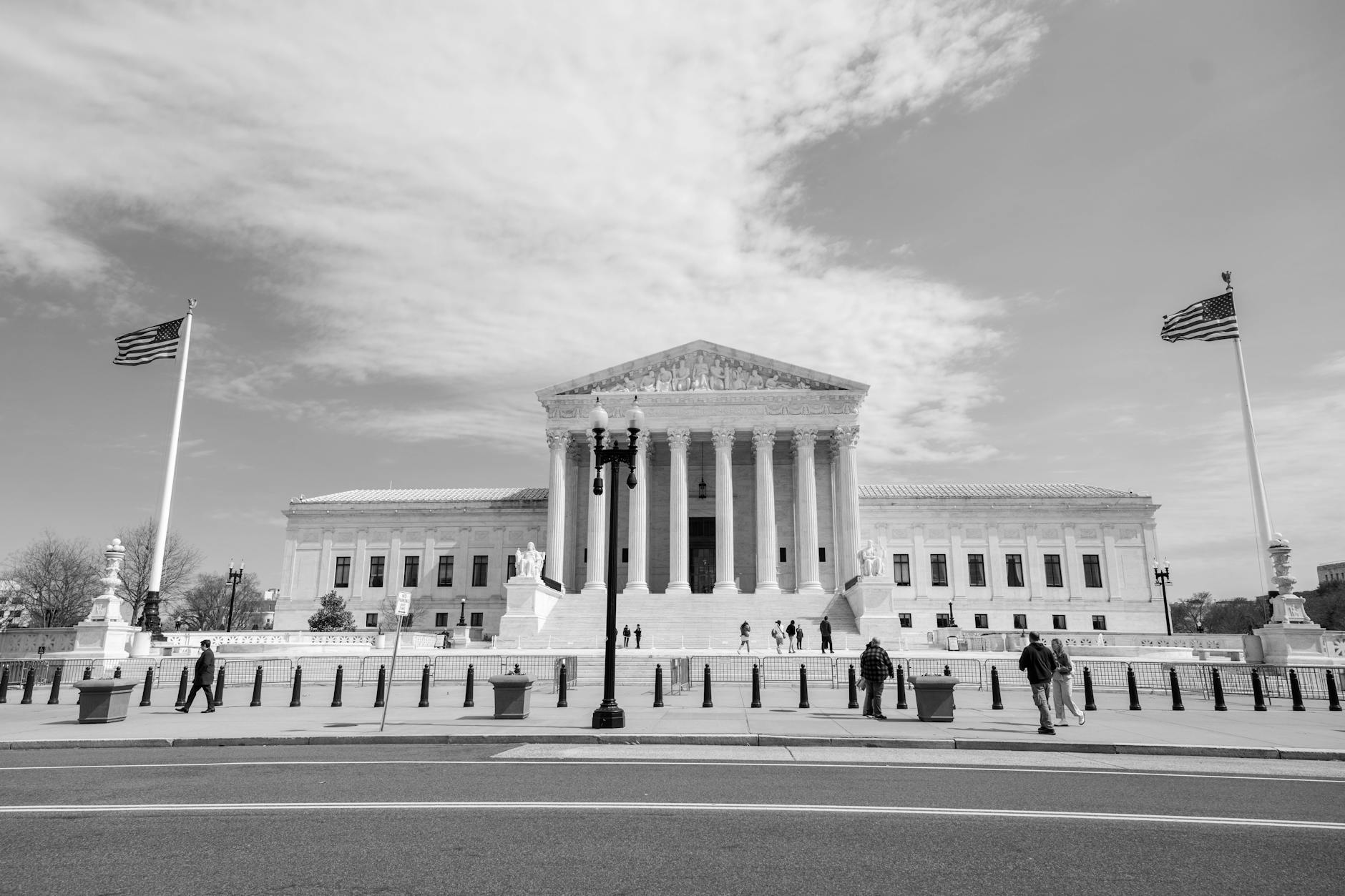
Justices to determine whether U.S. trade policy requires evidence, strategy, or merely a sharpie and an emotion.
\n
\n
In a landmark case for the nation’s ongoing experiment in improvisational governance, the U.S. Supreme Court heard arguments this week on whether a series of Trump-era tariffs were grounded in constitutional authority, economic theory, or what one justice repeatedly described as “pure, uncut vibes.”
At issue: billions of dollars in tariffs on China, Iran, and basically any country that looked at America with what former officials termed “a disrespectful supply chain energy.” The Court must now decide if the president can unilaterally launch a trade war after reading half a headline about steel on his phone.
Oral Arguments And Other Things No One Prepared For
Government lawyers insisted the tariffs were lawful under a statute allowing restrictions on imports that threaten national security, broadly defined as “anything that makes a cable news chyron look weak.”
“The president had robust evidence,” a Justice Department attorney said. “He saw a chart once. It had arrows. Some were red. It was extremely concerning.”
Counsel for affected businesses argued the tariffs were “economically incoherent, procedurally chaotic, and apparently drafted during a commercial break.” One justice then asked whether that description was specific to these tariffs or “just the country now.”
“If a president can declare Canadian aluminum a national security threat, what stops a future administration from sanctioning Wisconsin cheese?” worried one trade lawyer, prompting a brief but genuine panic from two justices from dairy states.
Capitol Hill Demands Answers, Receives PowerPoint
While the Court wrestled with the metaphysics of tariffs, top Biden trade officials faced a Senate hearing where lawmakers sternly demanded a “coherent long-term strategy” before immediately pivoting to ask whether they were “being tough enough in a theatrical way.”
Pressed to explain current policy, the U.S. Trade Representative unveiled a 62-slide deck titled “Winning The Future: A Multi-Phase, Data-Driven Response To Whatever Happened In 2018.” The central graphic, sources say, was an infinite loop labeled “Impose Tariff → Hold Press Conference → Blame Fed → Repeat.”
“Our approach is simple,” one senior official testified. “We are carefully reviewing the previous administration’s chaotic ad‑libbing to determine how best to continue it in a rules-based manner.”
Another aide offered a more technical justification: “Look, if we remove some Trump tariffs, people will say we’re weak on China. If we keep them, people will say we’re Trump. Our solution is to replace them with new, more confusing tariffs that no one understands, including us.”
Markets Brace For Supreme Court To Discover ‘Tariff Undo’ Button
Economists warn that if the Court invalidates the tariffs, the United States could enter an era of “post-chaotic trade policy,” in which decisions are forced to follow laws, data, and possibly a sentence with both a beginning and an end.
Inside the West Wing, staffers reportedly fear that a clear ruling could set a dangerous precedent: future presidents might be expected to justify economic measures with something more than a feeling and a televised frown.
In an emergency memo, the National Economic Council advised agencies to “prepare for all outcomes, including the worst-case scenario: the Court asking us what our actual plan is.” As of press time, officials were drafting a backup plan to simply rebrand every tariff as “a freedom subscription fee.”
Should the Court strike down the duties, observers say the administration may be forced to undertake the gravest step imaginable in modern Washington: holding a press conference that acknowledges cause and effect.
Until then, America’s trade posture remains what it has been for years: a professionally managed disaster, with excellent letterhead.
Reality Check
The real news: The U.S. Supreme Court is reviewing several tariffs imposed during Donald Trump’s presidency, many of which targeted imports from China and other countries. These cases focus on whether the tariffs were lawful under existing trade and national security statutes. At the same time, Biden administration trade officials have been questioned on Capitol Hill about how they plan to handle those tariffs and shape current U.S. trade policy. The satire above exaggerates this legal and policy debate into a full-blown bureaucratic farce.
\n
Satire disclaimer: This article is satire and parody. It is not factual reporting.
\n
Original source: facebook.com
\n
\n
Image credit: Quang Vuong — source. Show a visible credit link to Pexels on the site.
[…] Supreme Court To Decide If Trump Tariffs Are Legally Just “Vibes” […]
[…] Supreme Court To Decide If Trump Tariffs Are Legally Just “Vibes” […]