

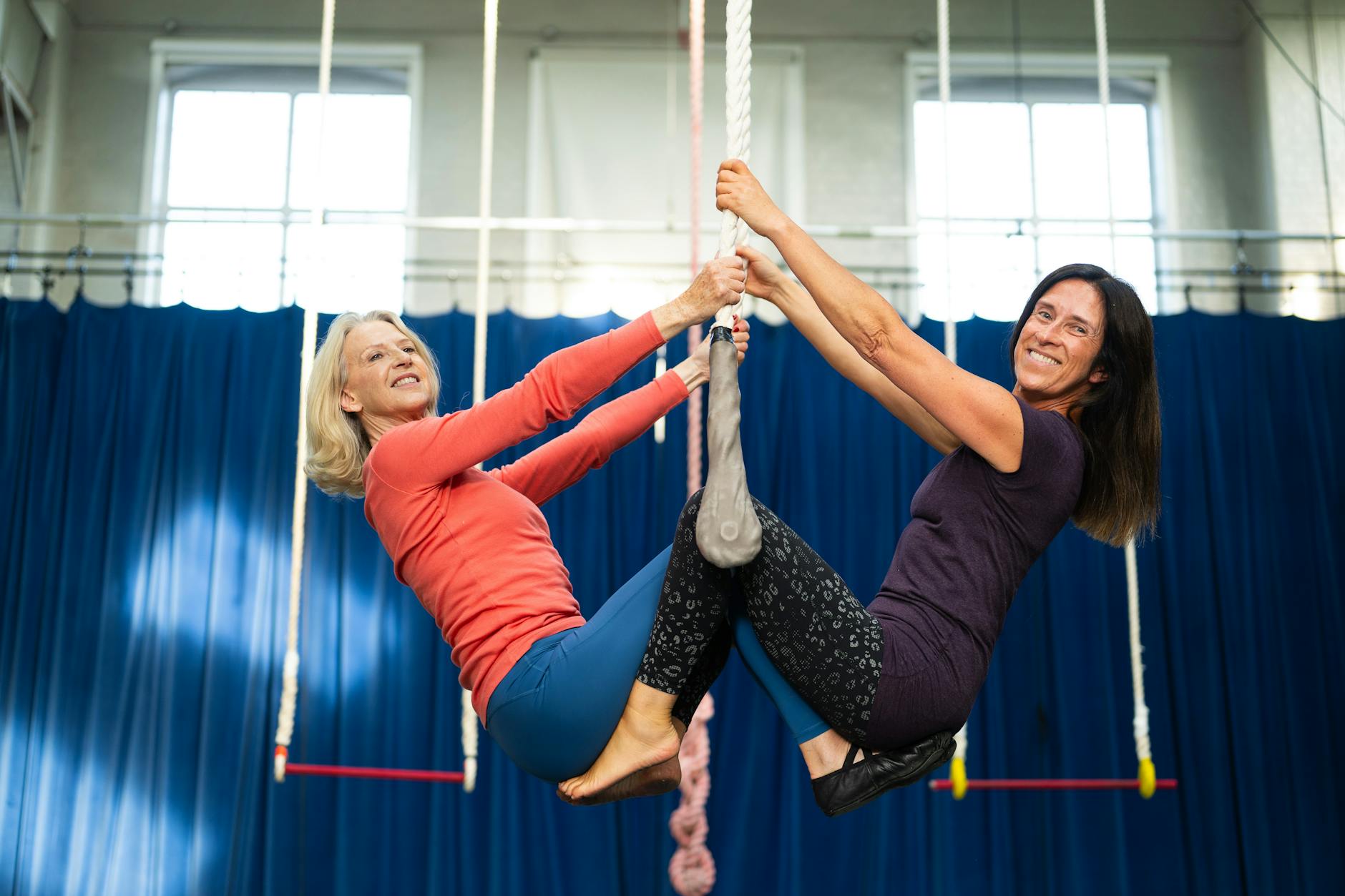
Nation alarmed to learn clowns, jugglers, and tightrope walkers will now be trained exclusively by the U.S. political system.
After years of ignoring basic infrastructure, public health, and climate policy, the United States has finally found a crisis it is uniquely unqualified to handle: the nation’s only accredited circus school is closing, and nowhere in Washington is there a plan to replace it that does not involve several members of Congress volunteering their résumés.
Circadium, a contemporary circus school in Philadelphia and the lone institution in the country where students could earn a legitimate degree in the fine art of not dying mid-backflip, is shutting its doors after failing to secure sustainable funding. This has raised an urgent question among policymakers: without a professional pipeline, what happens to the next generation of ethically trained clowns in a democracy that desperately relies on them for cultural continuity?
Washington Discovers It Has Been Running a Parallel Circus All Along
The announcement triggered immediate concern on Capitol Hill, where lawmakers quickly realized there is now a non-zero chance that future political satirists will have to distinguish between “circus performer” and “Member, House Freedom Caucus.”
“We cannot allow a circus skills gap to form,” said Rep. Harold Blakes (R–Somewhere Suburban), speaking at a hastily arranged press conference outside a Rayburn office suite currently under renovation to accommodate a ball pit. “If we don’t act now, in ten years we’ll have an entire Senate Banking Committee unable to juggle more than two conflicting donor interests at once.”
Blakes then attempted to demonstrate his commitment by walking across a strip of blue painter’s tape on the floor while reading a lobbyist’s memo. He fell immediately, but aides later stressed his “remarkable core strength.”
In a bipartisan show of unity, several senators introduced the P.R.A.T.F.A.L.L. Act (Performing and Recreational Arts Training for American Lifelong Leadership), which would designate circus arts as “critical workforce development,” alongside cybersecurity and drone warfare, as long as graduates agree never to unionize, ask for health insurance, or join a protest within 500 feet of a campaign fundraiser.
An early draft of the bill included loan forgiveness for anyone able to juggle three flaming sabers while reciting the federal budget; this provision was removed after staffers discovered that the Congressional Budget Office had already been doing this for years.
Health, Beond, and the RFK Jr. Tightrope Initiative
The closure of the circus school has also alarmed America’s booming “alternative wellness” sector, which had recently discovered that hanging from silks upside down in a warehouse was cheaper than therapy and came with better lighting for Instagram.
A wellness startup called beond (spelled in all lowercase to convey that capitalization is a form of structural violence) issued a statement lamenting the loss of “a crucial partner in our mission to fuse breathwork, circus, and venture-backed self-actualization.” The company had reportedly been in talks with Circadium to offer a signature program: “Trauma-Informed Trapeze for Founders.”
“We were this close to a Series C,” said beond CEO Kira Lane-Whittaker, holding a reusable water bottle filled with something that looked suspiciously like Champagne. “Our pilot showed that 83% of participants reported feeling ‘significantly more aligned’ after being gently pushed off a platform while a coach shouted, ‘Trust the net, babe, imagine it’s your liquidity event.’”
Meanwhile, independent presidential candidate Robert F. Kennedy Jr., whose entire health platform is a three-ring circus of vaccines, environmental toxins, and unlicensed longevity hacks, has seized on the closure as proof of systemic bias against “unorthodox body literacy.”
“We are watching the intentional destruction of America’s last true preventative health care system,” Kennedy said in a podcast interview recorded while walking on a slackline over a shallow koi pond. “Do you know how many injuries are prevented every year because someone learned to fall correctly from a unicycle? Big Pharma doesn’t want you asking that question.”
Kennedy then proposed redirecting $20 million in federal research funds to study whether a daily regimen of handstands, raw milk, and shouting at clouds could replace flu shots for children “who identify as circus-adjacent.” Fact-checkers noted the proposal had no chance of passing but would likely poll at 17% among voters searching “how to detox from wifi” at 2 a.m.
“Official Explanation”: Circus School Fails Federal Clown Compliance
In a written response that somehow managed to be both bureaucratic and avant-garde, the Department of Education offered its own explanation for why America’s only accredited circus school was unable to secure federal funding.
“After a comprehensive multi-year review, we determined that Circadium’s curriculum did not sufficiently align with the federal Clown Competency Model (CCM), which emphasizes standardized test performance, passive classroom posture, and the ability to sit perfectly still for eight hours while someone talks at you about derivatives. While we respect the art of juggling, current statute prioritizes the juggling of standardized assessment categories over the juggling of physical objects.”
The statement went on to clarify that, under current regulations, a program devoted to landing gracefully after being launched from a cannon cannot be classified as “career and technical education” unless it leads directly to employment at Amazon.
“We have nothing against circus arts,” the statement added, “but our mandate requires us to support only those educational programs that train students to thrive in the actual American workplace: staring into a screen, suppressing emotions, and pretending to be impressed by Slack emojis.”
Circus educators, already familiar with catching people who fall out of the sky, were nonetheless stunned by the logic.
“We teach balance, risk assessment, trust, improvisation under pressure,” said a Circadium instructor who requested anonymity for fear of being reassigned to a charter school. “The federal government’s position is that these skills are ‘not directly transferable.’ Have they… have they met Congress?”
The Moment Everything Went Fully Off the Rails
The crisis reached its inevitable escalation when a group of entrepreneurial lawmakers proposed folding circus arts into school safety and mental health initiatives, on the theory that if children are going to grow up in a country like this, they might as well know how to fall properly.
The “Resilient Futures Through Acrobatics” pilot program, unveiled at an education summit sponsored by three test-prep companies and a hedge fund, would replace gym class with a mandatory “Daily Gauntlet of Uncertainty.” Students would be asked to:
• walk a low balance beam while reading about climate projections;
• juggle foam balls labeled “health care,” “rent,” and “retirement” until one inevitably drops;
• hang from a trapeze while guidance counselors explain student loans.
“We’re not saying a ten-year-old needs to know how to perform a backflip dismount from a moving train,” said Deputy Undersecretary of Education for Innovative Outcomes Marla Duquesne. “We’re just saying it wouldn’t hurt, given how things are trending.”
In a demonstration that was either deeply moving or profoundly disturbing, officials invited a class of middle school students to try the course. Within minutes, several had mastered the art of the trust fall, in which a student closes their eyes and falls backward into the arms of their peers.
“This is a powerful metaphor for community care,” said Duquesne, moments before one student, asked to fall backward into the arms of “Market Forces,” hit the floor with a dull thud.
Million-Dollar Solutions, Shoestring Arts
While the circus school scraped for grants and scraped even harder for rent, policymakers pointed out that it was unrealistic to expect meaningful federal support for a niche institution when there were so many urgent demands for the nation’s dollars, such as building additional private jets for people who tweet about carbon footprints.
A review of recent spending priorities revealed that a single year of subsidies for an experimental drone program—designed to deliver farm-fresh kale to tech executives too spiritually exhausted to leave their infinity pools—could have fully endowed the circus school, funded scholarships, and provided free physical therapy to every performer forced to land on concrete because the budget for mats was cut.
“The circus arts are important, yes,” said one budget committee staffer, speaking on background. “But we live in a time of hard choices. For instance, should we spend another hundred million dollars on a missile system that does not technically work but polls very well, or should we teach a generation of young people how to collaborate, improvise, and literally catch each other? You see the dilemma.”
Pressed on whether he would support even a modest arts funding increase, the staffer paused, stared into the middle distance, and then asked if this counted as an on-the-record conversation or just “emotional juggling.”
When the Circus Leaves, What’s Left?
The closing of America’s only accredited circus school means that, for the first time in modern history, there will be no formal, federally recognized pathway for citizens who wish to devote their lives to organized chaos, risky stunts, and carefully choreographed illusions designed to distract the public from the underlying structure holding it all together.
That work, as always, will remain the exclusive jurisdiction of national politics.
In the absence of institutions like Circadium, the country will continue to rely on its familiar, unaccredited sources of spectacle: 24-hour news panels, viral school board brawls, and the ongoing experiment of asking local election officials to perform a daily high-wire act between facts and a Facebook comment section.
America did not lose its only circus—it lost the only one that insisted on safety protocols, rehearsal, and tuition assistance.
The other circus never needed accreditation to begin with.
Reality Check
The satire above is based on real news: Circadium School of Contemporary Circus in Philadelphia, founded in 2017, is the first and only accredited circus school in the United States. Despite accreditation, the school has struggled to access sustainable funding and is now closing, highlighting broader challenges facing arts education and nontraditional training programs in the U.S. The real story involves funding structures and accreditation rules rather than any actual congressional plan to replace circus training with politicians.
Satire disclaimer: This article is satire and parody. It is not factual reporting.
Original source: Billy Penn
Image credit: Centre for Ageing Better — source. Show a visible credit link to Pexels on the site.