

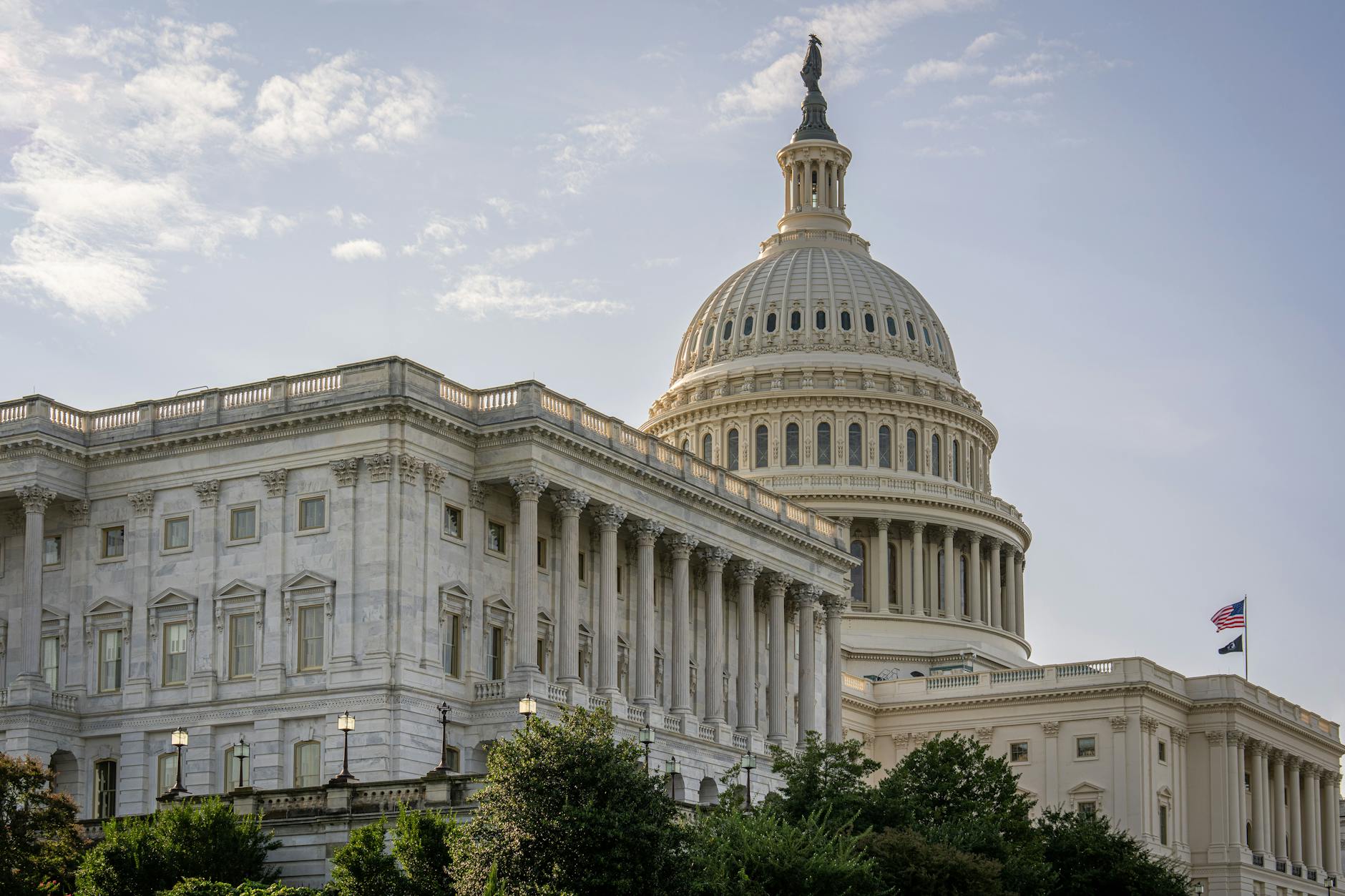
A completely reasonable response to an unreasonable political news cycle.
In a solemn display of bipartisan alarm, the United States Senate this week held a high-stakes hearing on the rising nuclear threat from China and Russia, then immediately adjourned to debate who had stolen the Committee’s reserved parking spot.
At a hearing that staffers billed as “Cuban Missile Crisis, but with better visuals,” senators listened to intelligence officials, defense experts, and at least one PowerPoint animation of missiles arcing elegantly over the Pacific while a red warning banner helpfully read: “THIS IS VERY BAD.”
“We are entering a new and dangerous era,” intoned one witness, a strategic forces analyst, as a senator behind him silently tried to unmute themselves on the committee’s video system for the seventh time. “China is expanding its nuclear arsenal, Russia is rattling its own, and the U.S. nuclear posture remains designed for the technological possibilities of 1987 and the budget politics of 2024.”
America Confronts Existential Peril, Checks Phone, Scrolls On
Committee members from both parties took turns expressing grave concern that the United States is falling behind in the global contest of civilization-ending capabilities. Several lamented that China may soon possess as many deployable warheads as the average American thinks are already in “Area 51 or wherever.”
“The American people deserve to know that we are taking this threat seriously,” said one senator, dramatically tapping a stack of briefing folders they later admitted were “mostly printed emails and a Sudoku.” “Our adversaries are modernizing; our deterrent is aging; our doctrine is fuzzy; and yet my biggest classified briefing this week was about a TikTok filter.”
For nearly three hours, senators cycled through a standard range of nuclear anxieties: warhead counts, delivery systems, missile defense, command-and-control vulnerabilities, and, briefly, whether anyone in the room could clearly explain what “tactical” is supposed to mean when attached to the word “nuclear.”
“Let me be absolutely clear,” said the ranking member. “If China and Russia continue on this path, the United States will be forced to update at least three PDF documents and possibly a flow chart.”
Staffers, speaking on background, confirmed that the flow chart has not been updated since 1994 and “still has a box that just says ‘Call Moscow, hope for best.’”
The Official Explanation: Nothing to Worry About, Everything is Urgent
Following the hearing, the Committee released a formal summary, written in the traditional language of Washington reassurance-panic, declaring that “the current situation is both entirely under control and also a rapidly escalating crisis demanding immediate action at an unspecified future date.”
The official explanation insisted that the United States maintains an “unquestioned second-strike capability,” a phrase long understood to mean “we can still blow up the world even if we’re having the worst day imaginable.” However, in a new twist, the statement also noted that “budget constraints may require certain adjustments to the precise size, shape, and operability of Armageddon.”
Pressed to elaborate, one senior official clarified off-camera that these “adjustments” might include consolidating several nuclear command functions into a single multi-purpose app, very tentatively titled “NukeTok.”
“The interface will be familiar to younger officers,” the official said. “Swipe right for deterrence, left for de-escalation. We’re workshopping the ‘launch’ gesture.”
Pentagon representatives assured the Committee that robust safeguards would remain in place, including two-person authentication, biometric verification, and a pop-up asking, “Are you really, really sure?” before any civilization-ending decision.
Meanwhile, in the Great Power Group Chat
As senators invoked China and Russia with tones normally reserved for hurricanes and cable news ratings, they repeatedly emphasized that the United States must “send a message.” They were less specific about what that message should be, beyond “we’re serious this time” and “please don’t read our debt numbers.”
One senator argued that America’s soft power is also at stake. “If we look weak, our adversaries will doubt our resolve,” they warned. “And if they doubt our resolve, they may stop reading our strongly worded statements entirely and just skim the bolded parts.”
Another senator, apparently mixing briefing folders, asked whether Russia’s nuclear posture had been impacted by “the latest Supreme Court decision” and whether China was “coordinating any of this with Iran or that thing I saw on MSN this morning.” A staffer was later seen gently removing a printout of the MSNBC homepage from the senator’s binder.
Efforts to maintain decorum faltered when one member suggested the Committee hear from a panel of younger experts via video link. The connection froze just as an analyst began explaining hypersonic glide vehicles, leaving the word “hypersonic” frozen mid-syllable while missiles on the slide behind her appeared to hover politely in mid-fall.
“The Chinese are building silos in the desert,” the analyst eventually said, after reconnecting. “The Russians are fielding new systems. And our response so far has been largely limited to inventing more acronyms to describe how worried we are.”
Senators nodded thoughtfully and asked whether the acronyms were classified.
Escalation: The New Strategy Nobody Asked For
The hearing took a more surreal turn when a late-arriving senator proposed a compromise solution designed to “bring Americans together in this time of peril”: the creation of a national “Nuclear Awareness Month,” complete with red, white, and slightly glowing ribbons.
Under the proposal, schools would hold age-appropriate drills, such as “Duck, Cover, and Check Instagram One Last Time,” while adults would participate in community forums on deterrence theory moderated by retired game show hosts. Corporate sponsors would be encouraged to launch limited-edition “Mutual Assured Disruption” product lines.
“If we can’t beat China and Russia on warhead numbers,” the senator argued, “we can at least dominate the merch.”
Emboldened, another member suggested inviting former President Donald Trump to testify in a future hearing, “given his extensive personal experience with saying classified-sounding things on television.” The idea was quickly shelved after a parliamentary expert warned this could cause “an uncontrolled chain reaction of subpoenas, appeals, and Supreme Court footnotes.”
Yet the momentum of absurdity proved hard to stop. By the end of the session, the Committee had informally discussed:
– Rebranding nuclear modernization as “strategic infrastructure,” in the hope of sneaking it into a highway bill.
– Offering China and Russia joint naming rights to a future missile defense system, on the theory that “nobody wants to shoot down something they paid for.”
– Launching a bipartisan podcast called “Yield & Consequences,” where retired officials explain deterrence theory over ads for meal kits.
Everyone Very Concerned, To Revisit Issue in 6–18 Months
As the hearing concluded, members unanimously agreed that the nuclear threat from China and Russia is “grave,” “urgent,” and “requires us to act with the seriousness and foresight that have long been the hallmarks of this institution,” before immediately heading to their next commitments: a fundraising lunch, a local radio hit about gas prices, and an appearance on a Sunday show to reiterate how deeply concerned they are.
“We will not be caught flat-footed,” the chair vowed. “We will hold more hearings. We will commission more reports. We will produce a bipartisan letter with multiple signatories. Our adversaries will see our signatures and know: America still has printers.”
In the hallway afterward, a junior staffer summed up the day’s proceedings while ordering coffee on a government credit card.
“Look, everyone understands the stakes,” the staffer said. “We’re talking about weapons that could end civilization. It’s just that, between the campaign calendar, the court calendar, the Supreme Court calendar, and the news cycle, civilization keeps getting pushed to the afternoon session.”
The staffer checked their phone. A news alert announced that China had conducted another missile-related test. Another announced a new congressional letter “expressing concern.”
Thankfully, concern remains fully funded.
Reality Check
The satire above is based on a real U.S. Senate hearing about the rising nuclear threat posed by China and Russia. Senators heard testimony that both countries are expanding and modernizing their nuclear arsenals, raising concerns about U.S. deterrence, strategy, and readiness. The actual discussion focused on force posture, modernization programs, and the need to adapt U.S. policy to a more complex, multipolar nuclear environment. The underlying issue is a serious debate over how to prevent escalation and maintain stability as more actors increase their strategic capabilities.
Satire disclaimer: This article is satire and parody. It is not factual reporting.
Original source: lokmattimes.com
Image credit: Mark Stebnicki — source. Show a visible credit link to Pexels on the site.