

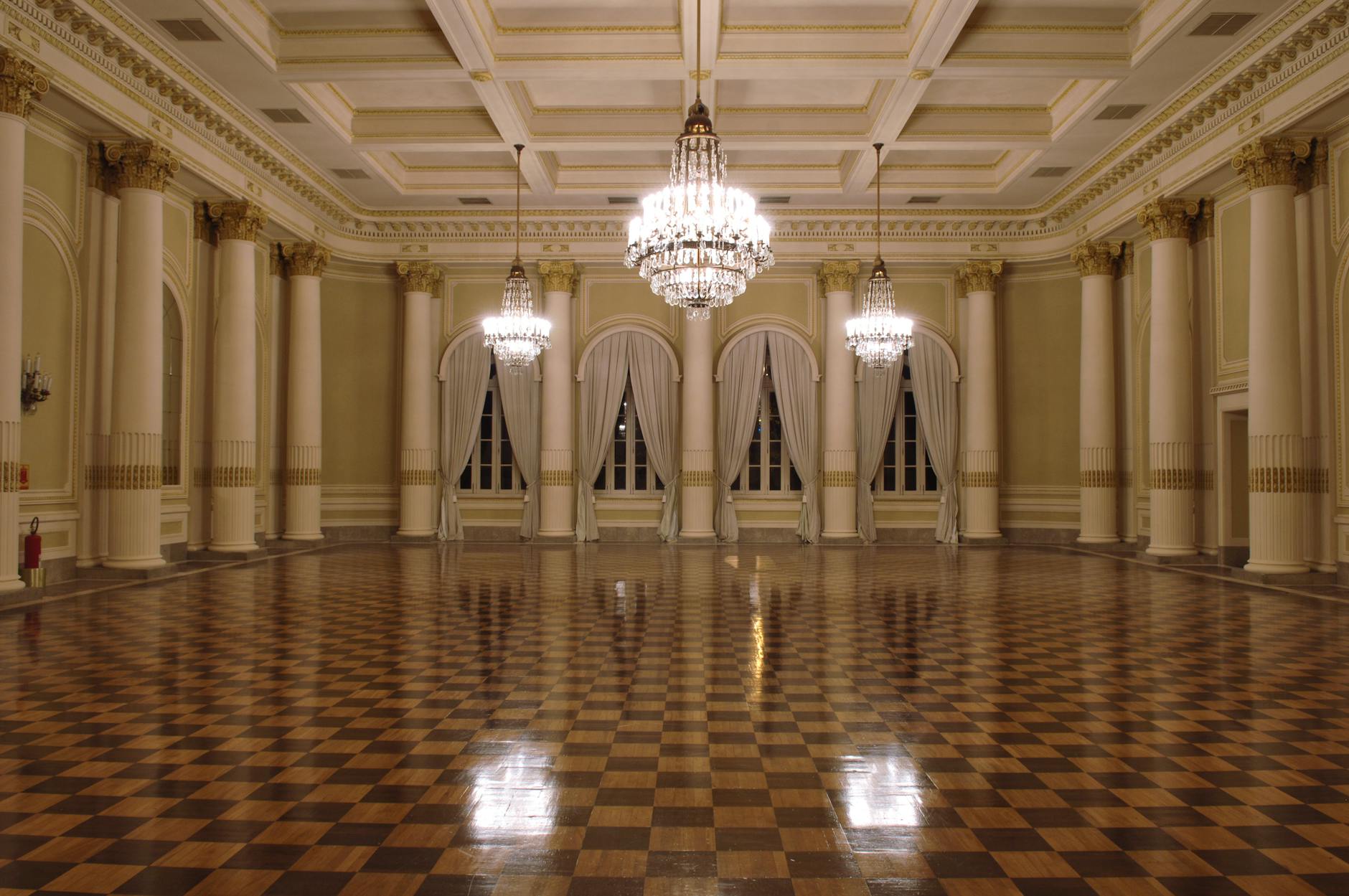
Guests will reportedly pass through three security rings before being cleared to waltz near the republic.
The White House has entered what fictional planners are calling the “ceremonial hardening phase” after President Trump described a future ballroom as drone-proof and connected to a military complex, requiring federal agencies to determine whether the building is primarily for state dinners, national defense, or aunt-level line dancing.
A draft satirical readiness memo circulating through the imaginary Office of Event-Based Deterrence classifies the ballroom as “a multipurpose hospitality bunker capable of withstanding unmanned aerial systems, adverse table assignments, and speeches by donors who believe they are brief.”
The proposed facility would reportedly include reinforced ceilings, restricted airspace, and a coat check staffed at a readiness level normally reserved for Indo-Pacific naval briefings. Guests would receive place cards, lapel pins, and a laminated explanation of why the shrimp tower falls under strategic infrastructure.
Reception Security Posture
Under the fictional Ballroom Defense Framework, all incoming guests would be screened for drones, suspicious corsages, and unauthorized attempts to move themselves closer to the head table. The Secret Service would maintain a secure perimeter around the dance floor, while a rapid-response etiquette team would neutralize uncleared toasts before they achieved altitude.
“The goal is simple: no drone, no canapé, and no emotionally complicated cousin enters the ballroom without a clearance determination,” reads the satirical memo.
The policy also creates a new alert system for formal events. Condition Ivory indicates normal dinner operations. Condition Gilded requires guests to stop filming the ceiling. Condition Supreme Court activates when two justices are seated near a chocolate fountain and nobody can agree whether that constitutes an appearance problem.
The Ballroom Doctrine
Congressional aides, in this fictional account, were briefed that the structure may require a Senate subcommittee on Tactical Merriment, with jurisdiction over chandeliers, blast-resistant curtains, and whether China could interpret synchronized dancing as escalation.
The White House social office would be merged with a command center, creating a single authority empowered to approve floral arrangements and monitor radar signatures. Seating charts would be treated as classified material after an early simulation showed that placing ambassadors, donors, and cable-news regulars in the wrong order could trigger a “regional grievance cascade.”
“This is not just a ballroom,” one imaginary procurement officer explained. “It is a forward-operating banquet environment with limited cocktail-hour vulnerability.”
MSN push alerts would be permitted only after dessert, to prevent guests from learning mid-salad that they were attending either a gala or a hardened installation. The court, should litigation arise, would be asked to decide whether a waltz conducted inside a military complex is speech, assembly, or procurement.
For now, fictional planners recommend calling the project “The East Wing Celebration and Air Denial Annex,” pending final approval from whoever controls the guest list.
Context
The BBC reported that Trump said a planned White House ballroom would be “drone-proof” and connected to a military complex. The remarks were part of broader discussion about a proposed addition to the White House grounds, which has drawn attention for its scale, cost, and security claims.
Satire notice: This article is satire and parody. It is not factual reporting.
Inspired by: BBC
Photo: Mauro Motozono
[…] White House Ballroom Reclassified as Drone-Proof Formal Military Complex […]